Food Setu.
A surplus food redistribution system from university messes to NGOs
1st place · India HCI 2024, IIT Bombay
Setu means bridge. Food Setu connects university messes that overproduce with NGOs that never have enough, designed around the four things that break redistribution in practice: time, safety, scale and trust.
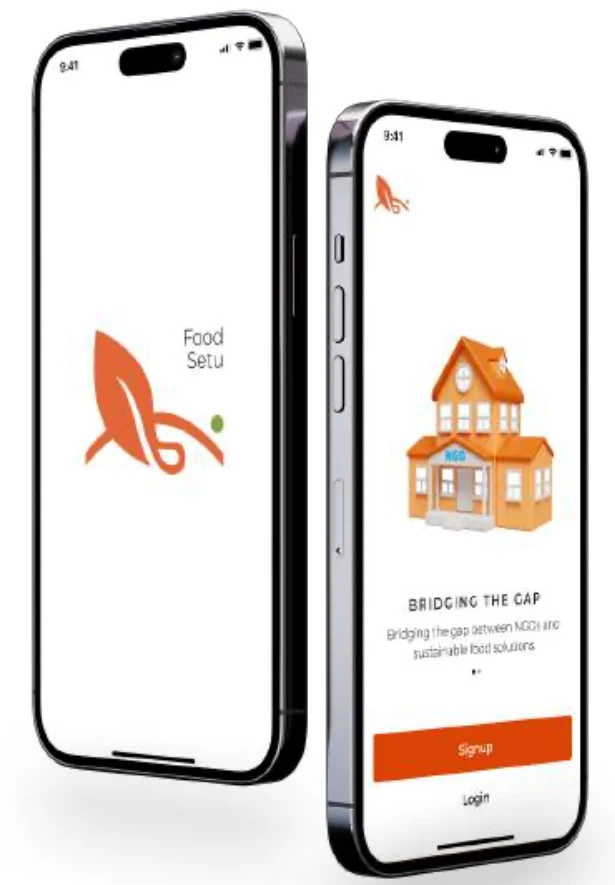
The problem
University messes throw away good food every day. NGOs nearby never have enough.
[What was going wrong]
Large quantities of edible food are wasted every day in university messes, because kitchens overproduce and there is no structured way to redistribute what is left. At the same time, NGOs face inconsistent access to food.
The redistribution that does happen relies on manual coordination: phone calls, informal contacts, someone remembering to check. That breaks down under time pressure, at scale, and whenever food safety is in question. The result is a gap between surplus being generated and surplus actually reaching people.
[Team and my role]
Food Setu was a three-person team project with Sahil Sinha and Vasu Pratap Singh, made for the India HCI 2024 student design challenge at IDC, IIT Bombay. We did the research together.
My part: I mapped the system flow, designed the app screens, built the prototype and pulled the research findings together into the constraints below.
Research
We talked to the people on both ends of the handover.
[Who we spoke to]
We interviewed hostel mess staff, NGO coordinators and a logistics partner. We asked how food gets passed on today, where safety worries come in, who calls whom, and how much time there really is between a meal ending and the food going bad.
[What we found]
- 2 in 4NGOs face food scarcity and lack enough food to feed their groups consistently
- 90%of NGO participants said they needed real-time tracking and confirmation updates
- Mostfood donors (restaurants, messes, families) reported spoilage from poor coordination and limited resources
[Where it breaks]
The same four problems came up in almost every conversation:
- Timing gaps between surplus and pickup
- Availability of fresh food
- Lack of trust between donors and NGOs
- Inefficient scheduling
[Constraints]
These became the four constraints every design decision had to answer to.
- Time
Food expires quickly
There is a narrow safe-use window after a meal ends.
- Safety
Quality must be verified
NGOs need to know what they are receiving is safe.
- Scale
Many messes, many NGOs
Multiple donors and receivers operate at the same time.
- Trust
Reliable sources
NGOs need predictable sources they can plan around.
Designing the system
Before drawing a single screen, I mapped how food should move.
[System flow]
[Design decisions]
Each decision answers one of the four constraints.
- 01Constraint
Food has a narrow safe-use window
Design decisionReal-time surplus listing and automatic NGO matching, with fixed pickup windows aligned to mess closing times to reduce delays and prevent spoilage.
- 02Constraint
Food quality must be verified
Design decisionClear food descriptions, quantity limits and verification steps built into the flow, so NGOs can assess safety without extra back-and-forth.
- 03Constraint
Multiple messes and NGOs operate simultaneously
Design decisionA centralised coordination system with automated notifications and scheduling, cutting manual communication and supporting parallel operations.
- 04Constraint
NGOs need predictable, reliable sources
Design decisionLive status updates and confirmations at each step, so every handover is traceable and trust builds over time.
The result
An app for messes and NGOs, plus packaging that keeps food safe on the way.
[Signing up]
NGOs and volunteers sign up separately. An NGO uploads its registration certificate, and has to accept the pickup rules before it can order anything. That answers the trust problem from both sides.
[Finding food]
The home screen lists nearby messes with what they cooked today, how far away they are and how long pickup takes. Food that has passed its freshness limit is marked as not available, so nobody orders food that is no longer safe.
[Ordering]
Checkout has two modes. Self-pickup costs Rs. 10 per kg. Delivery adds a fee and shows the delivery time and distance before the NGO commits. Every item has a weight limit set by the mess, so one NGO can’t take everything.
[After ordering]
Live tracking shows when the food will arrive and whether it is on time. In our research, 90% of NGO participants asked for exactly this. The profile keeps the NGO’s verification on record.
[Packaging]
Good coordination doesn’t help if the food spoils on the way. Food Setu uses eco-friendly bagasse containers with stacking grooves, carried in durable polyester outer cases that lock onto a vehicle. The system is built for bulk donations starting at 5 kilograms.
Looking back
[What I learned]
The screens were the easy part. Most of the work was figuring out who does what, and when, so food gets picked up before it goes off. Working inside real limits like closing times and food safety taught me that clear coordination matters more than extra features.